
How to Buy a Catamaran
How to Buy a Catamaran: The Complete Step-by-Step Guide (2026)
So You Want to Buy a Catamaran? Here's How the Process Works
Buying a catamaran is exciting, but if you've never purchased a cruising boat before, the process can seem a little overwhelming.
Where do you start looking? How do you know what a boat is actually worth? Do you need a broker? When do you make an offer? What happens after the seller accepts it?
These are questions we deal with regularly at Catamaran Brokerage, and I thought it would be helpful to walk through the process from the initial search all the way to closing.
Whether you're looking for your first cruising catamaran or moving from one boat to another, understanding the process ahead of time can save you quite a bit of time, frustration, and potentially money.
Step 1: Figuring Out What Catamaran You Actually Want
Before you start booking flights to look at boats, it's worth spending some time figuring out what you really want to do with your catamaran.
Are you planning to live aboard full-time? Cruise the Bahamas and Caribbean? Cross oceans? Spend weekends aboard with friends and family?
These are very different uses, and the right catamaran for one buyer might be completely wrong for another.
Budget is obviously a major consideration, but there are plenty of other factors worth thinking about.
How many cabins do you need? Is sailing performance important, or are you more interested in space and comfort? Are you comfortable maintaining complicated electrical and mechanical systems? Do you want a boat that's ready to go cruising, or are you happy to take on a refit?
One thing I often remind buyers is that there's no such thing as a perfect catamaran.
Every design involves compromises. Some boats prioritize sailing performance, others living space, and others ease of operation and maintenance.
Having a clear idea of your intended use makes it much easier to narrow down the options.
And sometimes, after looking at a few boats, buyers discover that what they originally thought they wanted isn't actually what suits them best. That's perfectly normal.
Step 2: Where Do You Find Catamarans for Sale?
Most buyers begin their search online.
Websites such as YachtWorld, brokerage websites, and various other boat listing platforms provide access to a large selection of catamarans currently on the market.
You can also find privately listed boats through owner groups, online communities, and social media.
At Catamaran Brokerage, we maintain our own listings of cruising catamarans, and we're always happy to help buyers search beyond the boats listed directly with us.
This is something that's worth explaining because not everyone understands how yacht brokerage works.
You generally don't need to contact a different broker for every boat you're interested in.
A buyer can work with one broker who helps identify suitable boats, coordinates with listing brokers, arranges viewings, and assists throughout the purchase process.
That broker can often help you purchase vessels listed by other brokerages as well as those listed directly through their own company.
For most buyers, having one knowledgeable person helping coordinate the search is considerably easier than dealing with a dozen different brokers.
Step 3: Why Work With a Catamaran Broker?
You certainly aren't required to use a broker to purchase a catamaran. Private transactions happen all the time.
However, a good broker can provide value well beyond simply showing you boats.
And I think this is particularly important when buying a cruising catamaran.
At Catamaran Brokerage, our focus is on cruising catamarans. These are the boats we work with, inspect, sail, maintain, and help people buy and sell.
That specialization matters.
A cruising catamaran has a different set of considerations from a sportfishing boat, a monohull sailboat, or a motor yacht. Understanding the differences between various builders, construction methods, layouts, electrical systems, engines, saildrives, and rigging configurations can make a real difference when evaluating a potential purchase.
A broker who understands these boats can help identify potential concerns early, provide insight into different models, and guide buyers toward boats that make sense for their intended use and budget.
There's also the market knowledge.
Understanding what a particular boat is actually worth involves considerably more than looking at the asking prices of a few similar listings.
We'll get into that shortly.
How Do You Choose a Broker?
My advice would be to find someone who genuinely knows the type of boat you're interested in buying.
Ask about their experience with cruising catamarans. Do they understand the differences between the various manufacturers and models? Are they familiar with the mechanical and electrical systems aboard these boats? Can they explain the buying process clearly?
And perhaps just as importantly, do they listen to what you're trying to accomplish?
A good broker shouldn't be trying to sell you the first boat you look at. They should be helping you find the right boat, even if that means advising you against buying one that doesn't make sense for your needs.
Communication is also important. You'll potentially be working together for weeks or months, so you want someone who's responsive, straightforward, and willing to give you an opinion, even when it might not be what you want to hear.
Step 4: Narrowing Down the Search
Once you've identified a few promising catamarans, it's time to start digging into the details.
Photos and listing descriptions are useful, but they only tell part of the story.
Two boats of the same model and year can be in completely different condition, depending on how they've been used and maintained.
One might have spent much of its life lightly used and professionally maintained, while another might have cruised extensively with years of deferred maintenance.
And sometimes the heavily cruised boat is actually the better-maintained one.
This is where asking the right questions becomes important.
How long has the seller owned the boat? Where has it been cruising? Have there been any major repairs or insurance claims? What equipment has been replaced or upgraded? Are maintenance records available?
A broker can help gather this information before you spend money traveling to see the boat.
Of course, sellers and listing brokers don't always have every answer, but the more information you can collect beforehand, the better.
Step 5: Traveling to See the Boats
Cruising catamarans can be located just about anywhere.
You might find a boat that looks perfect in Florida, another in the Caribbean, and another on the opposite side of the country.
Traveling to inspect boats can become expensive, particularly if you're booking flights, hotels, and rental cars for multiple viewings.
This is another area where having a broker involved can help.
A good broker can assist with preliminary research, ask additional questions, request specific photographs or videos, and help decide whether a particular boat is worth traveling to see.
If you're making a trip to view one boat, it may also make sense to arrange viewings of other suitable catamarans in the area.
I generally discourage buyers from making expensive travel arrangements based entirely on a listing description and a collection of attractive photographs.
The goal should be to narrow the search enough that when you do travel, you're looking at boats that genuinely deserve consideration.
Step 6: What Should You Look for When Viewing a Catamaran?
This is one of my favorite parts of the process because you can learn a tremendous amount about a boat simply by paying attention to how it has been cared for.
When you step aboard, take a good look around before getting distracted by the layout, the electronics, or the list of upgrades.
Is the boat clean? Does it smell musty? Are the bilges reasonably clean and dry? Is there corrosion around electrical connections? Are hoses and wiring neatly installed, or does everything look like it's been worked on by a dozen different people over the years?
Open lockers. Look behind access panels where possible. Spend some time in the engine compartments.
Are the engines clean? Are there obvious leaks? Is the wiring organized? Do the systems appear to have been maintained?
Look closely at the deck hardware, rigging, sails, windows, hatches, and general condition of the boat.
None of these things tells the entire story on its own, but collectively they can give you a pretty good idea of how much attention an owner has paid to maintenance.
And it's not just about cleanliness.
Some boats are beautifully polished for sale but have significant problems hidden behind the panels. Others might look a little tired cosmetically but have excellent mechanical systems and a long history of careful maintenance.
It's important to look beyond appearances.
What About Upgrades?
Many cruising catamarans have been extensively modified by previous owners.
Solar panels, lithium battery banks, watermakers, new electronics, air conditioning, generators, and other upgrades can make a boat considerably more appealing.
But the quality of those installations matters just as much as the equipment itself.
A boat with a long list of expensive upgrades isn't necessarily better than one with fewer upgrades that have been properly designed and installed.
Sometimes an impressive equipment list can actually hide a collection of poorly executed projects.
Try to evaluate the quality of the work, not just the dollar value of the equipment.
Step 7: What Is the Boat Actually Worth?
This is probably one of the most important questions in the entire process.
A catamaran's asking price is exactly that: an asking price.
It doesn't necessarily represent what the vessel will sell for, and it certainly doesn't establish its actual market value.
When evaluating a potential purchase, a broker can carry out a comparative market analysis, looking at similar vessels currently listed and, importantly, comparable boats that have actually sold.
Recent sold prices are particularly useful because they provide a much better indication of what buyers have been willing to pay.
Of course, no two used catamarans are exactly alike.
Age, equipment, location, maintenance history, overall condition, and even the circumstances surrounding the sale can affect value.
A boat that's recently received new standing rigging, sails, engines, and a properly installed electrical system might justify a higher price than a similar boat requiring all of those items.
But buyers should also understand that spending $100,000 upgrading a boat doesn't necessarily increase its market value by $100,000.
A good market analysis considers the boat as a whole.
At Catamaran Brokerage, this is a big part of how we help buyers. We want our clients to understand where a particular vessel sits in the current market before deciding what they're comfortable offering.
Step 8: Making an Offer
Once you've found a catamaran you want to purchase, the next step is making an offer.
In a typical brokerage transaction, this is done using a written Purchase and Sale Agreement, often referred to as a PSA.
The agreement identifies the buyer, seller, vessel, purchase price, deposit, important dates, and other terms of the transaction.
At Catamaran Brokerage, we commonly use the International Yacht Brokers Association (IYBA) Purchase and Sale Agreement.
Your broker will help prepare the offer and explain the various dates and conditions involved.
Some buyers assume they should always start with a very low offer, expecting the seller to negotiate aggressively.
Sometimes that approach works, but it can also be counterproductive.
A well-supported offer based on market conditions, the vessel's condition, and comparable sales is generally a better starting point than simply choosing an arbitrary percentage below asking price.
Every transaction is different.
Some boats are priced very competitively, while others may have been on the market for a long time at an unrealistic asking price.
Understanding the difference is important.
Step 9: Negotiating the Purchase
Once your offer is submitted, the seller can accept it, reject it, or respond with a counteroffer.
There may be some back-and-forth before both parties reach an agreement.
Negotiations aren't always just about price, either.
Closing dates, included equipment, repairs, location of delivery, and other conditions can all become part of the discussion.
This is one of the areas where having an experienced broker involved can help keep things moving.
Buying and selling boats can be emotional. Sellers often have years of memories attached to their vessels, while buyers are understandably concerned about making a substantial financial commitment.
A broker can help keep the discussion focused on the transaction itself rather than allowing emotions to take over.
Once the terms are agreed upon and the PSA is signed by both parties, the buyer generally pays the required deposit into escrow, subject to the agreement's terms.
At that point, the transaction moves into the inspection and acceptance stage.
Step 10: Are You Paying Cash or Financing?
Ideally, this is something buyers should have figured out well before making an offer.
If you're purchasing with cash, the process is generally more straightforward, although you'll still need to arrange for the funds to be available when required.
If you're financing, there are a few additional considerations.
Marine lenders may have requirements relating to the vessel's age, condition, insurance, survey, and the amount of money you're putting down.
It's worth speaking with lenders early in the process so you understand what financing might be available and what they will require.
One important point: don't assume that your purchase agreement automatically gives you a way out if financing falls through.
The standard IYBA Purchase and Sale Agreement we commonly use states that the buyer's obligation to purchase is not contingent upon obtaining financing.
If financing is going to be a condition of your purchase, it needs to be specifically addressed and agreed upon in the contract.
The same applies to insurance. It's worth investigating potential insurance coverage and costs before you're too far along in the purchase process, particularly with older catamarans or vessels intended for extended offshore cruising.
Step 11: The Marine Survey and Sea Trial
After the agreement has been signed and the deposit has cleared, the buyer typically arranges a marine survey and sea trial.
We've covered this process in considerably more detail in our separate article, What to Expect During a Marine Survey When Buying a Catamaran, but here's the basic idea.
The buyer hires an independent marine surveyor to inspect the vessel and report on its condition.
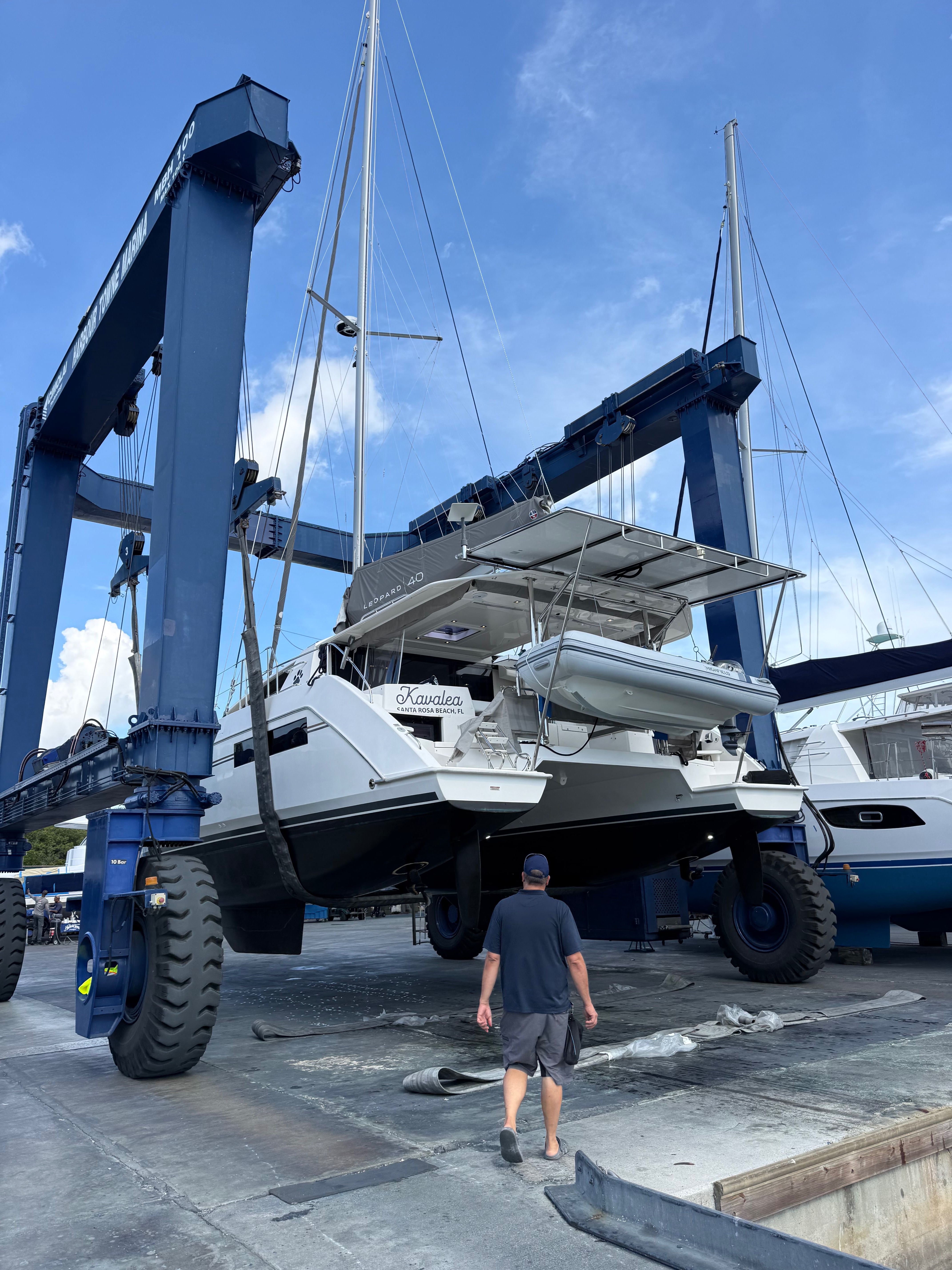
The survey generally includes an inspection of the vessel while afloat, a haul-out to inspect the underwater sections, and a sea trial to observe the vessel operating underway.
The buyer typically pays for the surveyor, the boatyard haul-out, and any additional specialists they choose to hire.
The seller is generally responsible for making the boat available, getting it to the boatyard, and covering operating expenses associated with the sea trial.
A surveyor will almost always find deficiencies, even on relatively new boats.
The important part is understanding which findings are routine maintenance items and which might represent significant unexpected problems.
Depending on the findings, the buyer may choose to accept the vessel, negotiate changes to the agreement, or reject the vessel within the terms of the contract.
Pay particular attention to the acceptance deadline specified in your PSA.
If additional inspections are required or the survey report is taking longer than expected, any necessary extension should be agreed upon and documented before that deadline expires.
Step 12: Accepting the Vessel
Once the buyer has completed their inspections and is satisfied with the results, they can formally accept the vessel.
Under the IYBA agreement we commonly use, acceptance must be provided in writing by the specified Accept/Reject Date.
Sometimes buyers will request a price adjustment or ask the seller to address particular deficiencies discovered during the survey.
These requests are subject to negotiation, and neither party should assume the other is automatically obligated to agree.
If the buyer accepts the vessel subject to conditions, that is treated as a proposal to amend the agreement rather than an unconditional acceptance.
Once the vessel has been accepted and any additional terms agreed upon, the transaction proceeds toward closing.
It's worth remembering that you're purchasing a used boat, and used boats will have imperfections.
The goal isn't necessarily to find a catamaran with absolutely nothing wrong with it. It's to make sure you understand what you're buying and are comfortable with its condition and the agreed purchase price.
Step 13: Preparing for Closing
The final stage is getting everything ready to transfer ownership.
Your broker will generally coordinate with the parties involved to make sure the required documents, payments, and other closing requirements are completed.
Depending on the vessel, this can involve title searches, checking for liens or other encumbrances, preparing bills of sale, dealing with US Coast Guard documentation or state registration, and coordinating with lenders or documentation agents.
The buyer will also need to arrange payment of the remaining balance, along with any applicable taxes and other expenses.
Insurance will generally need to be arranged to take effect when ownership transfers.
If the vessel is financed, the lender may have additional documentation and disbursement requirements.
It's important that the transfer of funds, ownership documents, and delivery of the vessel are properly coordinated.
In a typical closing, once all the requirements have been satisfied, the funds are disbursed, the ownership documents are transferred, and the boat officially becomes yours.
Congratulations. You've bought a catamaran!
Final Thoughts: Finding the Right Boat Is More Important Than Finding a Boat Quickly
Buying a cruising catamaran is a significant investment, and for many people it's also the beginning of a major lifestyle change.
It's worth taking the time to get it right.
Do your research, look at different models, ask plenty of questions, and don't feel pressured to purchase something simply because you've already spent time or money traveling to see it.
I've seen buyers change their minds about what they want after stepping aboard a few different catamarans, and that's often a good thing.
A knowledgeable broker should help you work through those decisions, not rush you into making one.
At Catamaran Brokerage, cruising catamarans are our specialty. Our experience with these vessels goes beyond simply listing and selling them. We understand the systems, maintenance considerations, construction differences, and practical realities of owning and cruising aboard a catamaran.
Whether you're just starting to explore the idea or you're actively searching for your next boat, we're happy to help you navigate the process, evaluate your options, and make an informed purchase.
Visit CatamaranBrokerage.com to browse our current listings or get in touch with our team.
The information in this article reflects common yacht brokerage practices and the IYBA Purchase and Sale Agreement frequently used in our transactions. Specific contracts, financing arrangements, expenses, and legal requirements may vary. Not tax or legal advice.