
What to Expect During a Marine Survey When Buying a Catamaran
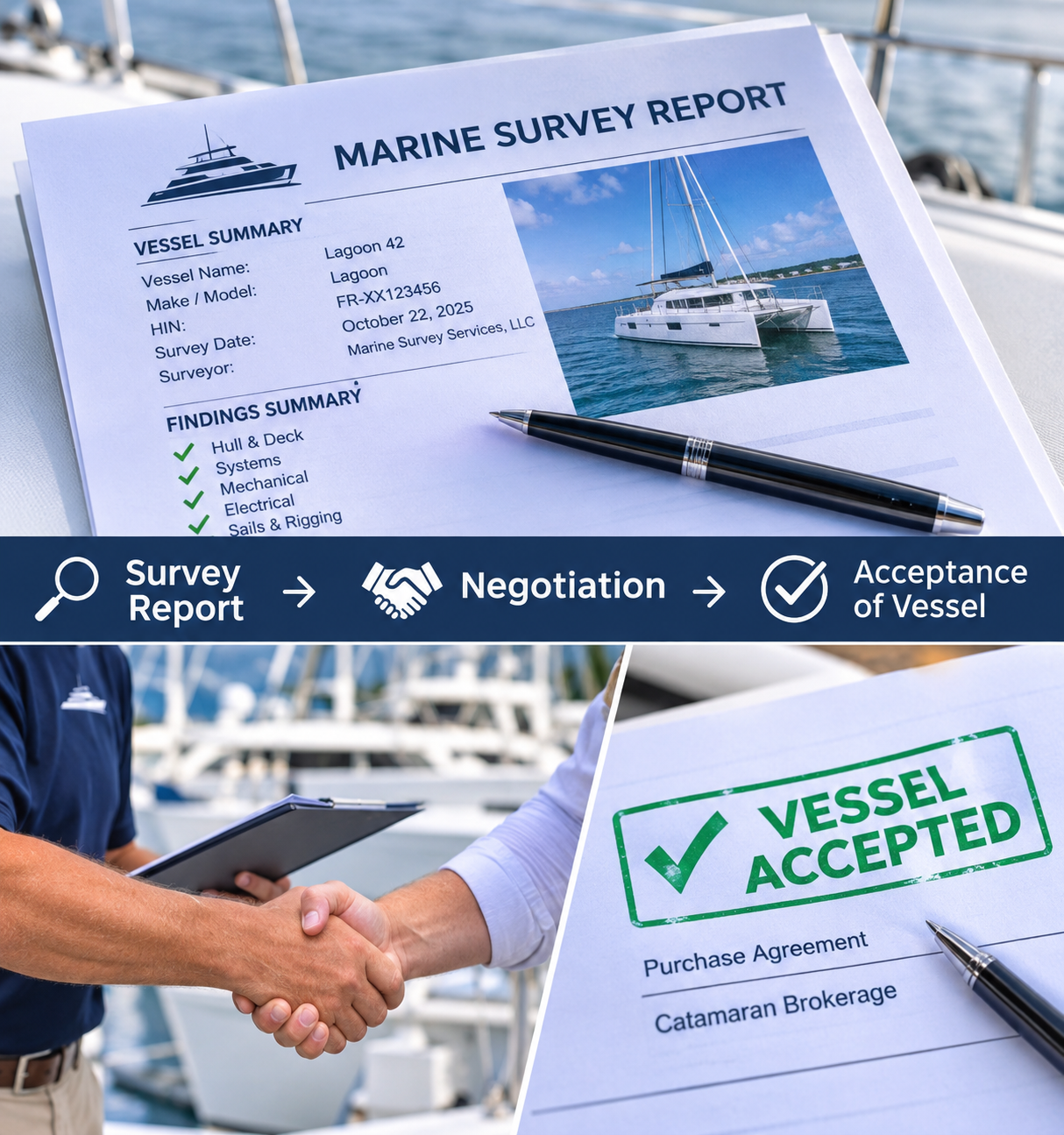
What to Expect During a Marine Survey When Buying a Catamaran
If you're buying a used catamaran, one of the most important parts of the process is the marine survey. It's also one of the parts that tends to cause the most confusion, particularly for first-time buyers.
Who hires the surveyor? Who pays to haul the boat out of the water? What happens if the surveyor finds problems? And does the seller have to fix everything on the survey report?
Having been involved in plenty of catamaran transactions over the years, I thought it would be helpful to explain how the process typically works, what to expect, and a few things buyers and sellers should keep in mind along the way.
What Is a Marine Surveyor?
A marine surveyor is an independent professional hired to inspect a vessel and report on its condition. Think of it somewhat like hiring a home inspector when purchasing a house, although there are some important differences.
A surveyor will examine the boat's structure, systems, equipment, and general condition, looking for defects, safety concerns, evidence of damage, and anything else that might affect its value or seaworthiness.
A good surveyor should be familiar with the construction and systems found aboard the type of vessel being inspected. Catamarans have some unique characteristics, so experience inspecting sailing or power catamarans is certainly worth considering.
One important thing to understand is that a surveyor is primarily there to identify and document findings, not necessarily to tell you how to repair everything or what those repairs will cost.
It's quite common for a surveyor to identify an issue and recommend consulting a specialist.
For example, they might suggest having a diesel mechanic investigate an engine concern, a marine electrician examine a wiring problem, or a professional rigger inspect a particular part of the standing rigging.
This doesn't mean the surveyor hasn't done their job. Quite the opposite. Recognizing when something needs further investigation by someone with specialized knowledge is part of doing a thorough survey.
Who Chooses the Surveyor?
The buyer generally selects and hires the surveyor, and the surveyor works for the buyer.
Your yacht broker can help by providing a list of surveyors operating in the area, but I don't believe a broker should be pushing a buyer toward any particular surveyor.
At Catamaran Brokerage, we encourage buyers to do their own research, speak with potential surveyors, and make their own selection.
It's worth asking about their experience with catamarans, their qualifications, what their inspection includes, and how quickly they expect to provide their report.
You can also ask to see a sample survey report. This can give you a pretty good idea of how thorough their inspections are and how clearly they communicate their findings.
When Does the Survey Happen?
In a typical brokerage transaction, the survey takes place after the buyer and seller have agreed on a purchase price and signed a Purchase and Sale Agreement (PSA).
The buyer will generally have paid a deposit into escrow, and the agreement will contain an acceptance or rejection deadline.
That deadline is important, and we'll come back to it shortly.
Once the agreement is in place, the survey, sea trial, and haul-out are scheduled. Ideally, all of this happens on the same day to avoid unnecessary expenses and logistical complications.
Depending on the boat, the surveyor, and the boatyard, the entire process can take most of a day, sometimes longer.
The Survey and Sea Trial Are Two Different Things
Although they usually happen on the same day, the survey and sea trial serve different purposes.
The survey is primarily an inspection of the boat's structure, systems, equipment, and overall condition. The surveyor will spend time going through the vessel, checking everything from electrical and plumbing systems to structural components, safety equipment, and signs of water intrusion.
The sea trial is the opportunity to observe the vessel operating underway.
On a sailing catamaran, that might include checking engine performance, steering, instrumentation, sail-handling systems, and other equipment that can only be properly evaluated while operating.
On a power catamaran, particular attention will generally be paid to engine operation, temperatures, RPM, steering, vibration, and the performance of the vessel underway.
A sea trial is not necessarily a comprehensive engine inspection. Depending on the boat, its age, and any concerns identified, a buyer may also want to hire a qualified diesel mechanic to carry out a separate inspection.
The Haul-Out: Getting the Catamaran Out of the Water
One of the most important parts of a survey is inspecting the underwater sections of the vessel.
This generally means taking the catamaran to a boatyard where it can be lifted out of the water using a travel lift or crane.
Not every boatyard can accommodate a catamaran. Beam is often the limiting factor, and some wider cats require specialized lifting equipment or a yard with a sufficiently large travel lift.
It's important to find a suitable yard well in advance of the survey date.
Once the vessel is out of the water, the surveyor can inspect the hull bottoms, keels, rudders, saildrives or running gear, through-hulls, and other components that aren't readily accessible while the vessel is afloat.
The hulls will generally be pressure washed so the surveyor can properly inspect the surfaces.
Surveyors may also use moisture meters and percussion testing to investigate areas of concern. These methods can be useful, particularly with cored construction, but they have limitations and don't necessarily tell the whole story. Additional investigation may sometimes be recommended.
Who Gets the Boat to the Boatyard?
Generally speaking, getting the vessel to and from the boatyard is the seller's responsibility.
If the seller is capable of operating the boat, they may choose to move it themselves.
If they aren't available or aren't comfortable operating the vessel, they may need to hire a captain. Typically, that captain would be an expense borne by the seller.
The seller is also generally responsible for the vessel's operating expenses associated with the sea trial, including fuel.
The buyer, meanwhile, typically pays the boatyard's haul-out and associated inspection fees.
These responsibilities should always be confirmed against the actual Purchase and Sale Agreement, as terms can vary.
What Does a Marine Survey Cost?
Marine survey pricing varies quite a bit depending on the location, surveyor, and type of vessel.
As a general guide, you can expect to pay somewhere between $25 and $45 per foot for a catamaran survey, although pricing is region-specific and some surveyors may charge outside that range.
For example, a 45-foot catamaran could cost approximately $1,125 to $2,025 for the survey itself.
The buyer generally pays the surveyor directly.
In addition, the buyer should budget for the boatyard haul-out and inspection fees, and any separately hired specialists, such as an engine mechanic or rigger.
Depending on the vessel and location, these additional expenses can add up, so it's worth understanding the total expected cost before scheduling everything.
While it might seem like a substantial expense, the survey is a relatively small investment compared with the cost of purchasing a catamaran, and it can potentially save you from some very expensive surprises.
What Is the Surveyor Actually Looking For?
A proper marine survey can cover a tremendous amount of ground.
The surveyor will generally inspect the hulls and deck structures, bulkheads, visible structural components, rigging, machinery spaces, electrical systems, plumbing, steering systems, safety equipment, and much more.
They're looking for obvious defects, but they're also looking for things that might indicate underlying problems.
Water intrusion around deck fittings, evidence of previous repairs, corrosion, unusual cracking, poorly installed electrical equipment, and deteriorating hoses are all examples of things that might attract attention.
Catamarans also have some particular areas worth inspecting, including crossbeam connections, bulkhead attachments, bridgedeck structures, rudder systems, and areas of the hull or deck that may have experienced unusual loading.
Of course, no surveyor can inspect every inch of a vessel. Access can be limited, equipment may be concealed, and some problems simply aren't detectable during a normal non-destructive inspection.
This is another reason why a survey should be viewed as an important part of the buying process, rather than an absolute guarantee that nothing will go wrong with the boat.
What Happens When the Surveyor Finds Something?
Here's something I frequently remind buyers: the surveyor is almost certainly going to find things wrong with the boat.
That's true of older catamarans, relatively new catamarans, and sometimes even brand-new vessels.
Boats are complicated, with an enormous number of mechanical, electrical, and structural components operating in a fairly harsh environment.
The important thing is understanding the significance of what has been found.
A survey report might identify routine maintenance items, minor safety concerns, aging equipment, installation deficiencies, or potentially serious structural problems.
These aren't all equal, and they shouldn't necessarily be treated that way.
For example, finding an old hose clamp that should be replaced is a very different situation from discovering a major structural problem that wasn't previously disclosed.
Some findings will require further investigation. If a surveyor recommends consulting a specialist, it's generally worth taking that recommendation seriously, particularly if the concern could be expensive to address.
I also encourage buyers to ask questions during the survey. Being present is a great opportunity to learn about the boat, understand its systems, and get a better feel for its overall condition.
How Long Does It Take to Get the Survey Report?
Most surveyors will discuss their significant findings with the buyer during or immediately after the inspection.
However, the formal written report generally takes a little longer.
A turnaround of approximately 2–5 business days is fairly typical, although some surveyors are faster and others may take longer.
It's important to establish this expectation before hiring the surveyor, especially when working within the acceptance deadlines of a purchase agreement.
And that brings us to one of the most important parts of the process.
The Acceptance Period: Don't Miss Your Deadline
When signing a Purchase and Sale Agreement, buyers and sellers agree to certain dates, including an acceptance or rejection deadline.
Under the IYBA Purchase and Sale Agreement we commonly use, the buyer has until the specified Accept/Reject Date to provide written notice of their decision.
This is something I strongly encourage buyers to pay attention to.
If your survey happens just a day or two before your acceptance deadline, and your surveyor needs five days to complete the report, you could find yourself in a difficult position.
Likewise, if the surveyor recommends bringing in an engine mechanic or another specialist, you need to make sure there's enough time to arrange that inspection and evaluate the results.
Don't simply assume that waiting for a survey report automatically extends your acceptance period.
If additional time is needed, speak with your broker about requesting an extension and getting that agreement documented in writing.
Under the IYBA agreement, failing to provide timely written acceptance results in the vessel being deemed rejected. Other agreements may have different provisions, so understanding the actual contract is essential.
Can You Renegotiate After the Survey?
Yes, and this is a fairly normal part of the boat-buying process.
But I think it's important for both buyers and sellers to approach these discussions reasonably.
When a buyer makes an offer on a used catamaran, they're generally making that offer with some understanding of the vessel's age, condition, and the information already available.
If you're purchasing a 20-year-old boat, it shouldn't come as a surprise that some components are 20 years old, or that there are maintenance items to address.
A survey isn't intended to be a shopping list of every little thing the buyer can ask the seller to replace.
On the other hand, if the survey reveals a significant problem that wasn't known or disclosed when the offer was made, it's entirely reasonable for the buyer to want to revisit the terms of the purchase.
Sometimes this means negotiating a reduction in the purchase price. Other times, the seller might agree to address a particular issue before closing.
And occasionally, a finding is serious enough that the buyer decides the boat simply isn't the right purchase for them.
Under the IYBA agreement, a buyer's acceptance subject to conditions is treated as a proposal to amend the purchase agreement. It doesn't automatically obligate the seller to agree to those conditions.
This is where having a good broker involved can be particularly valuable, helping both sides understand the findings, the practical implications, and what might be a reasonable solution.
Remember, There's Another Person on the Other Side of the Transaction
This is something I like to remind both buyers and sellers.
If you're buying a boat today, there's a pretty good chance you'll be selling one someday.
And if you're selling your boat, remember that you were once the buyer, probably with many of the same concerns and uncertainties.
It's easy for emotions to get involved during a boat transaction, particularly after a survey.
Buyers can become frustrated when unexpected problems are uncovered. Sellers can become defensive when a surveyor starts listing deficiencies on a boat they've owned and cared for, sometimes for many years.
Neither reaction is particularly helpful.
I always encourage people to keep things in perspective and try to understand the other person's position.
And here's another consideration: would you like to have a good working relationship with the seller after closing?
There is often a tremendous amount of knowledge that comes with years of owning a particular boat. The previous owner might know the quirks of its systems, where a particular wire runs, or the trick to getting some piece of equipment working properly.
Having a seller who's happy to answer the occasional question after closing can be extremely valuable.
Of course, sellers have no obligation to provide ongoing technical support, but maintaining a positive relationship certainly doesn't hurt.
The catamaran community is relatively small, and I think most people benefit from approaching these transactions with a little patience, fairness, and mutual respect.
Final Thoughts
A marine survey is one of the most important steps in buying a used catamaran.
It's an opportunity to learn more about the vessel, understand its condition, and identify potential problems before making the final decision to proceed with the purchase.
But it's also important to have realistic expectations.
A survey is not a guarantee that the boat will be problem-free, and finding deficiencies doesn't automatically mean you've found a bad boat.
What matters is understanding those findings, determining what they mean for you as the buyer, and making an informed decision.
With good preparation, a qualified surveyor, realistic expectations, and clear communication between everyone involved, the survey process doesn't need to be stressful.
And if you're considering buying or selling a catamaran, the team at Catamaran Brokerage is always happy to help you understand the process.
This article describes common brokerage practices and references the IYBA Purchase and Sale Agreement used in many transactions. Individual agreements and circumstances can vary, so buyers and sellers should always review the specific terms of their contracts.